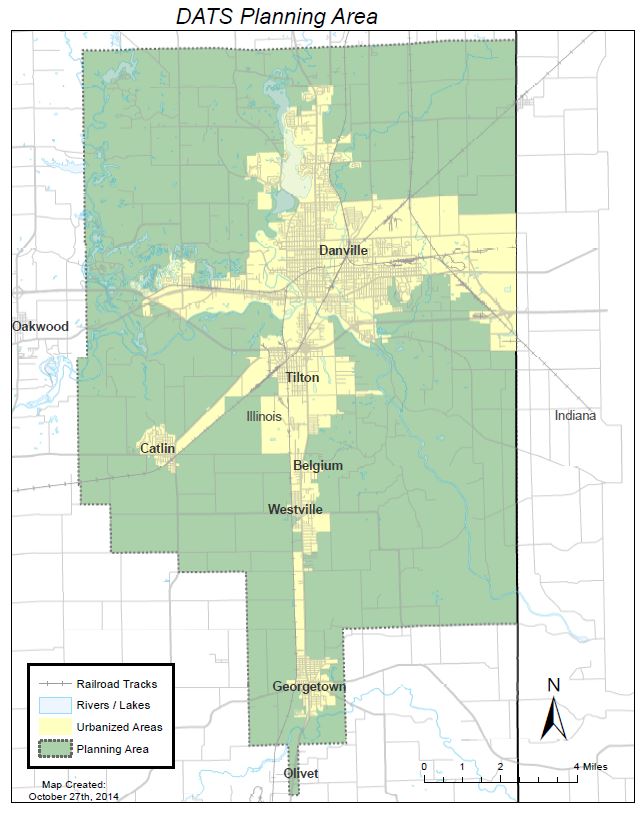
Danville Area Transportation Study (DATS) is the Metropolitan Planning Organization for the Danville, IL Metropolitan Planning Area
The Metropolitan Planning Process
The metropolitan transportation planning process investigates connections between mobility, multi-modal transportation systems, environmental conditions, economic development, and safety. It incorporates the concept of a 3-C planning process: Comprehensive, Cooperative, and Continuing. A cooperative planning process includes participation from a number of federal, state, local, private, and public agencies and individuals. This includes being consistent with the statewide transportation plan and consulting with other regulatory agencies.
The DATS Metropolitan Planning Organization
A key component of the metropolitan transportation planning process is the Metropolitan Planning Organization (MPO). The Danville Area Transportation Study is the designated MPO for the Danville Metropolitan Planning Area (MPA). DATS became the acting entity for the MPO in December 2002. DATS generates transportation planning and supports the goals and objectives of regional planning within the MPA. DATS engages governmental and nongovernmental transportation agencies within the MPA in order to create a coordinated transportation planning effort. DATS also provides a procedural framework to guide the function of the Policy, Technical, and Advisory Committees. The DATS committees include representatives from the City of Danville, the City of Georgetown, the Village of Tilton, the Village of Belgium, the Village of Westville, the Village of Catlin, Catlin Township, Danville Township, Newell Township, Georgetown Township, Vermilion County, Danville Mass Transit, CRIS, Vermilion Regional Airport, and the Illinois Department of Transportation.
The Metropolitan Planning Area
The multiple governmental entities listed above fall within the MPA boundary. The MPA boundary includes the Urbanized Area boundary, which is defined as including a central city and contiguous areas totaling at least 50,000 people and a density of over 1,000 people per square mile. This area also includes contiguous areas forecasted to become urbanized in the next 25 years. The boundary is established through a cooperative effort between IDOT and local officials and requires approval of the governor. The MPA encompasses city, village, township, and county governments in an effort to coordinate transportation planning for the region as a whole. The total population for the Urbanized Area as of 2000 was 53,223.
Core Functions of an MPO
- Establish a setting
- Evaluate alternatives
Evaluate transportation alternatives, scaled to the size and complexity of the region, to the nature of it's transportation issues, and to the realistically available options. - Maintain a Long Range Transportation Plan (LRTP)
Develop and update a long-range transportation plan for the metropolitan area covering a planning horizon of at least twenty years that fosters (1) mobility and access for people and goods, (2) efficient system performance and preservation, and (3) quality of life. - Develop a Transportation Improvement Program (TIP)
Develop a program based on the long-range transportation plan designed to serve the area's goals, using spending, regulating, operating, management, and financial tools. - Involve the Public
Involve the general public and all the significantly affected sub-groups in the four essential functions listed above.